

Everest’s Sherpas worry their place of origin is prone to showering away

 Laxman Adhikari
Sitting at an altitude of round 3,800m (12,467ft) is Thame, a little Sherpa village in Nepal’s Everest patch.
It’s house to many record-holding Sherpa mountaineers, together with Sherpa Tenzing Norgay, the primary individual to climb Mount Everest in conjunction with explorer Edmund Hillary.
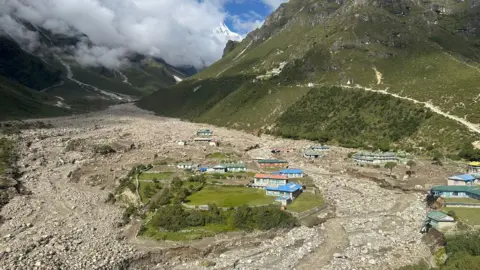
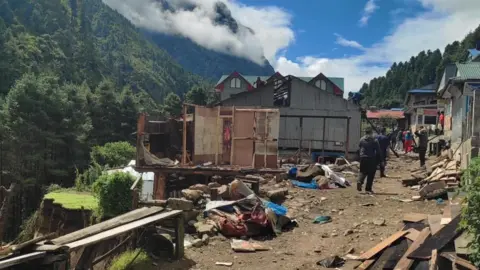
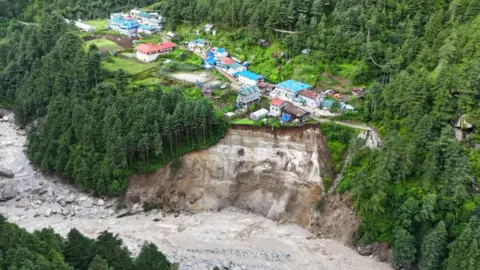
However on 16 August, the village used to be engulfed via chilly inundation waters later a frigid pond explode its banks, displacing some 60 community and destroying greater than a bundle properties and inns in conjunction with a college and fitness hospital.
The incident has left most of the village’s citizens – round 300 community – questioning if it is even shield to are living there to any extent further.
‘We’re nonetheless in trauma’
Incorrect deaths or accidents have been reported, however contributors of the Sherpa family mentioned they have been fortunate that the inundation strike all over daylight, when everybody used to be wide awake and the indicators arrived temporarily.
“If this had happened at night time, between 200 to 300 people would have lost their lives,” Ang Tshering Sherpa, former president of Nepal Hiking Affiliation mentioned.
“We are still in shock, and we are still crying when we (villagers) talk to each other,” mentioned Yangji Doma Sherpa, a local of Thame who used to be born within the village.
“The bigger question is if this place is safe enough to live in now. This flood has shown that we face an even more dangerous situation now, and therefore people don’t feel safe.”
A few of Thame’s citizens are living nomadic life and are living in numerous villages relying at the season.
However on this case, even villagers downhill from Thame had been affected.
“Because of the flood some parts of our village was swept away… luckily we managed to run up the hill,” mentioned Pasang Sherpa at Tok Tok village which is sort of two days’ trek downhill from Thame.
“The otherwise milky and frothy river turned so dark brown, with boulders and debris being swept down.
The sound and the sight was so scary that I am still shaken. I have taken refuge in a nearby village and am thinking if I should ever go back to Tok Tok.”
Locals say a lot of the chance might be diminished if there have been right kind tracking mechanisms for frigid lakes positioned upstream from human settlements.
Date a couple of lakes have drawn the eye of scientists and government, they added, the left-overs are merely overlooked.
In the meantime, crisis preparedness is non-existent in lots of villages.
“A few villages downstream of the Imja glacial lake have been trained on how to run in case of a flood,” Ms Doma Sherpa said.
“But there has been no training in our village whatsoever.”
Of the more than one dozen glacial lake outburst incidents recorded in Nepal in the past 50 years, four have been in the Everest’s Dudhkosi river basin.
One occurred upstream of Thame in 1985, when a large avalanche cascaded into the Dig Tsho glacial lake and created a wave that overtopped the dam. The ensuing flood destroyed a hydroelectricity plant downstream and caused more than three million dollars worth of damage.
 Khumbu Pashanlhamu Rural Municipality
Tiny lakes, fat dangers
The lack of monitoring is not a problem that is unique to just Thame.
There are thousands of glaciers and glacial lakes in the Himalayas – but very few in the Everest region are monitored and have early flood warning systems installed.
Meanwhile, global warming is accelerating the melting of glaciers which can fill up the lakes to bursting point.
A 2021 study led by the University of Leeds found that Himalayan glaciers have lost ice ten times more quickly over the last few decades than the average rate measured since their expansion 400 to 700 years ago.
Another study published in the Nature journal in 2022 found that Mount Everest’s South Col Glacier may have lost half its mass since the 1990s as a result of warming.
Imja Lake below Mount Everest was drained in 2016 after officials found it was in danger of overflowing and flooding downstream settlements, trekking trails and bridges.
But scientists have found that many new lakes have formed in recent years, while others have expanded and joined up to become larger ones.
Further inflaming the risk is the destabilisation of the local landscape caused by fast-retreating glaciers, leading to more landslides and avalanches that can pour into the lakes and cause them to rupture.
Authorities say they have listed around two dozen glacial lakes across the Nepali Himalayas as risky – but the two that burst on 16 August were neither mentioned in that list nor monitored by officials.
“They were the smallest ones and no one cared about them, and yet the damages have been so huge,” said Mr Tshering Sherpa.
“Imagine what could happen if the big ones burst out. There are many of them in the Everest region.”
Officials from Nepal’s Disaster Risk Reduction and Management Authority (NDRRMA) conducted a helicopter inspection and found there were a total of five small glacial lakes located near the source of the flooding. One of them had partially burst; another had burst completely.
“Which means the three other lakes at the same location could burst out anytime in the same way,” said Ms Doma Sherpa.
“Now that people know that, they don’t feel safe anymore. We are worried particularly about elderly people because of their mobility issues.”
 Khumbu Pashanlhamu Rural Municipality
‘Cut off from the outside world’
Since then, the impacts of global warming on Himalayan glaciers and lakes has only become more striking – and locals say some damages from floods are now irreparable.
While the Thame river used to flow through the left part of the Khumbu valley, Friday’s flood has made it change course. Now it flows right through the village, claiming almost half of the land.
“Much of the remaining land now is full of debris and boulders,” Ms Doma Sherpa said.
“This is not like rebuilding the houses destroyed by the quake. When you have no land left, what can you build on?”
The flood has also damaged the reservoir of the only hydropower station that provides electricity to the region.
The station stopped functioning after the disaster led to deposition of mud and debris in the reservoir.
“As a result, power supply has been cut off, and because of that telecommunication systems were also not functioning,” Mingma Sherpa, chair of a youth club at Namche, a major tourist spot near Thame, said.
“The area has remained cut off from the outside world since the disaster struck. This is quite scary.”
“We had been worrying about slow onset impacts of climate change, like dwindling water resources, but this disaster has shown how unsafe and vulnerable we are.”
Government officials are aware of locals’ fears.
Anil Pokhrel, head of NDRRMA, mentioned the authority is now initiation a staff of mavens that can “study the risks posed by the three remaining lakes upstream of Thame village and find out if the downstream settlement areas are safe for people to live in or not”.
“We are also working on disaster risk reduction in the region,” she added.
Participants of native Sherpa communities, then again, say they’ve visible extra communicate and no more motion over time relating to coping with dangers from frigid pond outbursts.
“We hear all big plans, especially during conferences, and soon the plans are forgotten,” Ms Doma Sherpa mentioned.
“But we can’t forget about what this flood has done – and that there are other lakes lurking up there that can unleash disasters on us anytime.”