

Grateful Dead Members Share Secrets to Six Decades of Giving Back: ‘People Support Us — And We Reciprocate’
On Sept. 13, 1988, the media assembled on the United International locations for a press convention. Representatives for the nonprofits Greenpeace, Cultural Survival and Rainforest Motion Community sat sooner than them, along the U.N. Surrounding Programme’s director and 3, much less anticipated emissaries: the Grateful Dead’s Jerry Garcia, Bobby Weir and Mickey Hart.
The band used to be about to start out a multinight fall run at Madison Sq. Field and had made up our minds to form the 9th and ultimate live performance of the stint a rainforest receive advantages. Garcia, Weir and Hart weren’t on the U.N. as rock stars; they have been there as activists.
“Somebody has to do something,” Garcia instructed the assembled population, sooner than including wryly, “In fact, it seems pathetic that it has to be us.” Because the target audience applauded and Hart and Weir voiced their word of honour, Garcia abbreviation in the course of the din: “This is not our regular work!” 11 days next, in a extra usual atmosphere, the band invited Bruce Hornsby, Corridor & Oates and Suzanne Vega, amongst alternative artists, onstage on the sold-out receive advantages demonstrate, which grossed $871,875, in keeping with an October 1988 factor of Billboard.
At the press conference, Garcia had stated, “We hope that we can empower our own audience with a sense of being able to do something directly and actually having an effect that’s visible in some way.” However he’d additionally expressed the Lifeless’s trepidation relating to activism.
“We don’t want to be the leaders, and we don’t want to serve unconscious fascism,” he stated. “Power is a scary thing. When you feel that you’re close to it, you feel like you want to make sure that it isn’t used for misleading. So all this time, we’ve avoided making any statements about politics, about alignments of any sort.” Past Garcia’s remark wasn’t totally correct — the ’88 receive advantages used to be a long way from the primary while the Lifeless had aligned itself with a trigger — its sentiment used to be fair: He understood the affect his cherished band wielded.
“As a young fan, I really learned about the issue in the rainforest from the Grateful Dead when they did that press conference,” recollects Mark Pinkus, who began visible the band in 1984 and used to be a faculty pupil in 1988. “If a band like the Grateful Dead took the time to care about a cause, it definitely got our attention as young fans.”
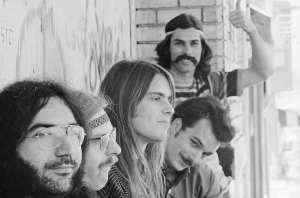
From left: Jerry Garcia, Phil Lesh, Bob Weir, Invoice Kreutzmann and Mickey Hart outdoor San Francisco’s Pristine Potrero Theatre in 1968.
Malcolm Lubliner/Michael Ochs Archives/Getty Photographs
For a then-17-year-old David Lemieux, who had began visible the Lifeless the 12 months sooner than and whose father labored on the U.N. from 1953 to 1973, “it added this huge level of legitimacy to this band I was following around” for his oldsters. “It certainly had me go out and learn more about [the issue],” he displays. “To this day, the way I view the world is very much what I learned from my days on tour — and seeing the Dead take a stance that was so big … meant a lot to me.”
On the while, Pinkus and Lemieux have been impressionable younger Deadheads. Nowadays, they’re central to the Lifeless’s gift and pace trade. Pinkus is president of Rhino Leisure, the Warner Track Workforce department that publishes the Lifeless’s archival releases, and Lemieux, the band’s legacy supervisor and archivist, is in detail concerned within the curation of the ones releases.
It’s telling no longer simply that the Lifeless’s trade is shepherded through contributors of the very nation it fostered, however that the band’s philanthropic paintings specifically resonated with Pinkus and Lemieux from the leap. The Lifeless’s contributors haven’t simply been philanthropically energetic because the band’s 1965 formation within the Bay Section — they’ve been forward-thinking, reimagining the potential for the nice works musicians can do and provoking alternative artists to practice of their footsteps. The entire occasion, their activism has consumed — and been fed through — their passionate lovers.
“We’re part of a community, and so the better the community is doing, the better we’re doing,” Weir says as of late. “Jerry always used to say, ‘You get some, you give some back.’ It just makes sense.” And because the starting, “that’s been our mode of operation,” the Thankful Lifeless’s Invoice Kreutzmann says. “We help people and give them stuff. It’s just a good way to live life. I wish that more people in the world lived life that way, instead of wars and bombings.”
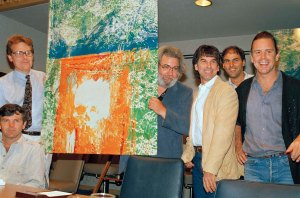
From left: Randy Hayes of Rainforest Motion Community (seated), Dr. Jason Clay of Cultural Survival, Jerry Garcia, Mickey Hart, Peter Bahouth of Greenpeace and Bob Weir at a Pristine York press convention in 1988.
Marty Lederhandler/AP
Since Garcia’s loss of life in 1995, the Lifeless’s surviving contributors have endured to excursion — and endured to recommend for the reasons that subject to them. That’s why MusiCares, the charitable group that the Recording Academy based in 1989 to aid the tune nation’s condition and welfare, is spotting the Thankful Lifeless as its 2025 MusiCares Individuals of the Time.
“It all follows in that tradition of teaching the industry what it should know about,” Hart says. “That’s that Grateful Dead kind of style, where we just did it because we knew it was the right thing to do. If we wanted to do this the rest of our lives was the idea, we have to do these things, because people support us — and we reciprocate.”
“Everybody had everybody’s back in the Haight-Ashbury, and we were a big functioning organism,” Weir recollects. “And we had roles within the community.”
It’s a dehydrated, mid-November night in Chicago, the place Weir, 77, has simply spent the afternoon doing what he does perfect: taking part in Thankful Lifeless tune. He’s on the town for 2 displays on the Auditorium Theatre with the Chicago Philharmonic Orchestra, which is able to accompany him and Wolf Bros, his stream solo venture, and next rehearsing “Weather Report Suite” and “Terrapin Station” — two of the Lifeless’s densest, maximum enthusiastic compositions — he’s again on his excursion bus, reminiscing in regards to the band’s early days.
Even after, philanthropy used to be core to the gang. It all started appearing as The Warlocks in mid-1965, and occasion accounts range about when, precisely, it modified its title next that 12 months, many consider it debuted its famed moniker on Dec. 10 — at Mime Troupe Enchantment II, the second one in a order of advantages for a satirical San Francisco theater troupe that steadily clashed with native regulation enforcement over separate accent.
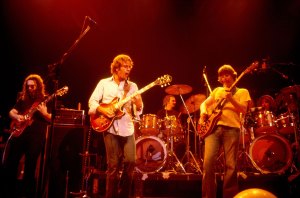
From left: Jerry Garcia, Bob Weir, Invoice Kreutzmann, Phil Lesh and Mickey Hart onstage on the Oakland (Calif.) Auditorium in 1979.
Ed Perlstein/Redferns/Getty Photographs
The primary decade or so of the Lifeless’s philanthropy “is an incredibly eclectic mix,” Lemieux says. In San Francisco, the band gigged for radical activists, arts areas, religious facilities (a Hare Krishna temple, a Zen monastery) and tune schooling. Because the band grew, it performed for hippie communes and tune venues, for hanging radio staff and bail finances, for the Lightless Panthers and the Hells Angels. It carried out with the Buffalo (N.Y.) Philharmonic Orchestra in 1970 to aid the ensemble; in a live performance that was one among its maximum respected reside recordings, the Lifeless performed in Veneta, Ore., on Aug. 27, 1972, to save lots of the native Springfield Creamery.
“We saw something in need, and we would just write a check,” Hart, 81, recollects as of late. “The Grateful Dead, we never thought of business. We just wanted to play, play, play.”
“That was really delicious for us, to make everybody happy,” says Kreutzmann, 78. “Because that’s the goal: Make everyone happy, not just the band.”
However because the band’s following grew all the way through the ’70s, that charitable means — guided through the band’s beneficiant perspective, which supposed numerous “yeses” and no longer many “nos” — was untenable. It had to streamline its operation. “We had always been given to community service, but we just wanted to get organized about it,” Weir says, alluding to the tax burden of the band’s preliminary type.
So the Lifeless did one thing that used to be after brochure for a musical office: It began a base. In 1983, the band’s early co-manager Danny Rifkin (who held quite a few roles within the workforce’s orbit over time) helped it starting The Rex Underpinning, named for Rex Jackson, a roadie and excursion supervisor for the band who had died in 1976. The base eradicated the desire for the Lifeless to do the forms of one-off, cause-based advantages it had achieved in the past, in lieu directing income from its charitable tasks into the base, which after dispensed that cash — next favor through its board, which integrated the band’s contributors and others in its interior circle — to diverse provide recipients. By way of refusing to just accept unsolicited provide proposals (packages have been, and nonetheless are, submitted through the Rex board and the ones within the Lifeless’s prolonged nation) and focusing its grants on organizations with mini, from time to time minuscule, budgets, the Lifeless retained the homespun really feel of its previous charitable efforts.
The Rex Underpinning temporarily was the principle beneficiary of the Lifeless’s philanthropy. The band performed its first Rex advantages in San Rafael, Calif., in spring 1984 and made some extent of staging multishow Rex receive advantages runs — in most cases within the Bay Section or within sight Sacramento — yearly for the remainder of its occupation. “They were just regular gigs, there was no other fanfare, but the money would go to The Rex Foundation,” Lemieux says. “We all thought that was pretty darn cool. It wasn’t like the Dead played any less hard because it was a benefit gig. The Rex Foundation mattered to them.”
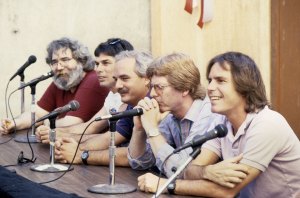
From left: Jerry Garcia, Mickey Hart, Invoice Kreutzmann, Phil Lesh and Bob Weir at Berkeley’s Greek Theatre in 1985.
Richard McCaffrey/ Michael Ochs Archive/ Getty Photographs
Over the nearest decade, the Lifeless performed upwards of 40 Rex advantages. With out the requirement {that a} given demonstrate receive advantages a particular investmrent — and with the bigger grosses Lifeless displays now earned — “it allowed the money to be spread a lot more,” Lemieux explains. A beneficiary “wouldn’t be like a multi-multimillion-dollar organization that needed $5,000. It was a $10,000 organization that needed $5,000. That makes a huge difference.” (Weir, Hart and Garcia’s widow, Carolyn, and daughter, Trixie, are some of the present-day board contributors of Rex, which nonetheless holds advantages and disburses grants; in July, Twilight Big name Orchestra, which re-creates vintage Lifeless displays, performed a receive advantages on the Greek Theatre in Berkeley, Calif., to proclaim the base’s fortieth per annum.)
All the way through this era, the Lifeless additionally endured to play games non-Rex advantages for explicit reasons, together with AIDS analysis and eye-care group Seva. The 1988 rainforest receive advantages used to be a hybrid — the uncommon Rex receive advantages with pre-announced beneficiaries in Greenpeace, Cultural Survival and Rainforest Motion Community. “Those were all people that we had already funded to in their infancy,” says Cameron Sears, who controlled the band within the overdue ’80s and ’90s and is as of late Rex’s government director. (Because it occurs, Sears’ entrée into the Lifeless’s global as a up to date faculty grad within the early ’80s used to be thru philanthropy: He’d pitched the band on getting excited about California H2O politics.) As Garcia put it on the U.N., “We’ve chosen these groups because we like that direct thing … We don’t like a lot of stuff between us and the work.”
The type continues to reverberate thru a tune business the place it’s now regular for primary artists to have charitable foundations. “The fact that all these bands now have looked to that model and replicated it, [the Dead] don’t need to take credit for it, even though it may rightly belong to them,” Sears says. “They’re just happy that people are doing it. Their vision has had a multiplier effect now around the world. What Eddie Vedder and Pearl Jam are into might be different than what Phish is into and is maybe different than what Metallica is into. But together, the amount of philanthropy that’s being generated through all these different people makes an incredible difference.”
Hurry up with reference to any bootleg of a Phil Lesh demonstrate from 1999 thru his loss of life in October, and also you’ll see a monitor between the top of the second one eager and the beginning of the encore, typically referred to as “Donor Rap.” Lesh gained a life-saving liver transplant in 1998; henceforth, he worn his platform to inspire Deadheads to show to their family members and say that, if the rest took place to them, they sought after to be an organ donor.
Upcoming Garcia’s loss of life, the Lifeless’s surviving contributors remained energetic musically — and philanthropically. When The Alternative Ones — the primary vital post-Garcia iteration of the Lifeless comprising Weir, Lesh, Hart and a forged of supporting musicians — debuted in 1998, it did so with a receive advantages, elevating greater than $200,000 for the Rainforest Motion Community. All of them championed reasons remarkable to them: Weir with the circumstance and fighting poverty, Hart with tune treatment and mind condition, Kreutzmann with ocean conservation, Lesh together with his Unbroken Chain Underpinning, which benefited a litany of items together with tune schooling. The Rex Underpinning has additionally remained energetic, supporting a territory of organizations around the arts, schooling, social justice, Indigenous peoples’ teams and the circumstance.
And, over time, the band contributors started to paintings extra carefully with MusiCares. Early within the pandemic, Lifeless & Corporate — the traveling workforce shaped in 2015 through Weir, Hart and Kreutzmann and rounded out through John Mayer, Oteil Burbridge and Jeff Chimenti — and the Thankful Lifeless introduced weekly archival livestreams that raised $276,000 for the group’s COVID-19 Diversion Capitaltreasury. Lifeless & Corporate expanded the association to epic proportions on Might 8, 2023, when the band kicked off its ultimate excursion at Cornell College’s Barton Corridor in Ithaca, N.Y., the place it performed one among its maximum respected gigs 46 years previous to the past; the 2023 demonstrate raised $3.1 million, with part getting to MusiCares and part to the Cornell 2030 Mission, a campus group devoted to sustainability.
“If you want to talk about making a statement in modern times,” Pinkus says, “here they return to the venue of arguably the most famous Grateful Dead show ever, play the tiniest show that they play on a farewell tour, which is all stadiums, and then they turn around and do it as a fundraiser. It really spoke to everything about the Grateful Dead and Dead & Company’s commitment to giving back.”
“The industry is a very dangerous place at times,” Hart says. “When you get engulfed with the harder side of the business and fall through the cracks or stumble and you need some help getting your mojo back, that’s really what MusiCares does.”
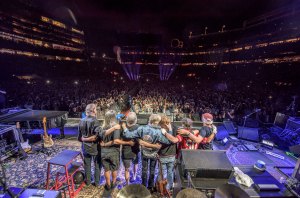
From left: Bruce Hornsby, Jeff Chimenti, Bob Weir, Phil Lesh, Phish’s Trey Anastasio, Mickey Hart and Invoice Kreutzmann at one of the crucial band’s Fare Thee Smartly displays at Levi’s Stadium in Santa Clara, Calif.,
on June 28, 2015.
Jay Blakesberg/Invision for the Thankful Lifeless/AP
Over the endmost decade, Activist Artists Control has helped information the band contributors’ philanthropic efforts. The corporate is each the executive of report for the Thankful Lifeless — a condition conferred through Thankful Lifeless Productions, an entity comprising the band’s dwelling contributors and representatives of Garcia’s and Lesh’s estates — and co-manages Lifeless & Corporate along Irving Azoff and Steve Moir of Complete Oppose Control. (Kreutzmann toured with Lifeless & Corporate from 2015 to 2022 however didn’t seem with the gang on its ultimate excursion in 2023 or all the way through its 2024 Las Vegas Sphere residency. On Dec. 4, Lifeless & Corporate introduced it’ll play games 18 displays at Sphere in spring 2025; a consultant for the band showed the lineup won’t come with Kreutzmann.)
“There was this mosaic of incredible good works that this band was doing, and there was a feeling that we could help amplify those good works and those dollars by putting a little more structure and support around it and a little bit more intentionality around it, which is what Activist came in and did,” Activist launch spouse Bernie Cahill says.
When discussing the Lifeless’s activism with the band and its associates, phrases like “apolitical” and “nonpartisan” arise steadily. As Kreutzmann places it, “It’s much more fun to see all the people smiling, not half the people bickering at the other half.”
“These are objective things that I think everyone will agree with,” Lemieux says of reasons starting from rainforest preservation to AIDS analysis. “And that’s what the Dead were kind of getting on board with and raising awareness.”
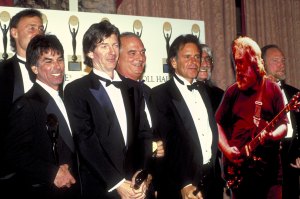
Mickey Hart, Phil Lesh, Invoice Kreutzmann, Bob Weir, Tom Constanten (with a cut-out standee of Jerry Garcia) and Vince Welnick of the Thankful Lifeless on the 1994 Rock & Roll Corridor of Popularity induction.
Steve Eichner/WireImage
However occasion it’s true that, each sooner than and next Garcia’s loss of life, the Lifeless’s contributors have have shyed away from the strident political rhetoric some alternative artists bias, the band has nonetheless complex aspiring reasons. Within the ’60s, it rubbed shoulders with radical teams in San Francisco’s Haight-Ashbury. Within the ’80s, when AIDS used to be a stigmatized subject, it headlined a peace demonstrate for Northern California AIDS companies.
That has endured in recent times. Lifeless & Corporate’s Participation Row — an department it allots at its displays for nonprofit and charitable companions — has featured entities just like the voter registration group HeadCount and the sustainable-touring workforce Reverb, amongst alternative social justice, environmental and family condition organizations, serving to the band to boost greater than $15 million since its 2015 debut. However Lifeless & Corporate have no longer shied from the usage of their traveling to platform extra contentious reasons. The summer time following the Parkland, Fla., highschool capturing, Lifeless & Corporate integrated the gun keep watch over workforce March for Our Lives on Participation Row. And next the Splendid Court docket overturned Roe v. Wade in June 2022, the band displayed pro-choice messages at its displays or even bought a “Save Our Rights” blouse reaping benefits ladies’s condition organizations.
“We support artists being authentic,” Cahill says. “If an artist feels called to speak out … our job is to make sure they have all the information so that they can speak intelligently on the matter. I think we’ve done a really good job with that over the years. We have both protected our clients and amplified their positions.”
And the Lifeless’s contributors have, judiciously, supported political applicants. Weir, Lesh and Hart performed a February 2008 receive advantages dubbed “Deadheads for Obama,” and that fall, Kreutzmann joined them for every other pro-Barack Obama gig. This autumn, each Weir and Hart publicly recommended Kamala Harris. Past “you don’t want to tell people what to do,” Hart explains, “there are some issues you must speak out [about] if you feel right about it and if you’re really behind it.”
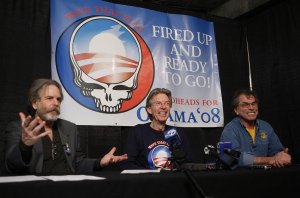
Bob Weir, Phil Lesh and Mickey Hart behind the curtain on the Warfield Theater in San Francisco at a rally for Barack Obama in 2008.
Carlos Avila Gonzalez/The San Francisco Chronicle/Getty Photographs
Because the Lifeless nears its sixtieth per annum in 2025 and provides its MusiCares honor to a long record of accomplishments — induction into the Rock & Roll Corridor of Popularity, a Grammy Lifetime Success Award, recipients of Kennedy Heart Honors, a recording integrated within the Library of Congress, amongst diverse others — its surviving contributors are emphatic that that is a long way from a denouement.
“Obviously, they’re quite humbled and honored by it all,” Cahill says. However “they always see these things as something that you get at the end of your career, when you’re done. And of course, these guys don’t feel like that’s where they are in their career. They feel like they have a lot more ahead of them, and I believe they do.”
Rhino continues to mine the Lifeless’s store for unused releases — its ongoing quarterly archival Dave’s Selections order helped the band split a report previous this 12 months in the past held through Frank Sinatra and Elvis Presley for many govern 40 albums at the Billboard 200 — and orchestrate vending partnerships from Igloo coolers to Nike footwear that safeguard the continued omnipresence of the band’s iconography. (“We’re always open for business — if it feels right,” Pinkus says.)
Most significantly to Deadheads, Weir, Hart and Kreutzmann are all resolute that they’ll stay at the street so long as they may be able to; in 2024, Weir toured with Wolf Bros and, together with Hart, staged Lifeless & Corporate’s 30-show Sphere residency, occasion Kreutzmann saved his livewire Billy & The Children office alive with Mahalo Lifeless, a three-day November tournament related his house in Kauai, Hawaii. Terminating 12 months, Weir toured supporting Willie Nelson, whom he’s shared expenses with for many years — and who at 91 is 14 years his senior. “His hands don’t work as well as they used to,” Weir says. “Nor do mine. But as the years go by, you learn to help the music happen through force of will. And Willie is as good as he’s ever been.”
Strength of will is one thing the Lifeless’s surviving contributors have in spades. “These guys have always been the outsider,” Cahill says. “They’ve flourished by being the outsider and by being a maverick and doing things their own way. Because they’ve written their own rules, they’re not beholden to anybody. They’re not looking for anyone’s approval, and they continue to write their own rules and to do things that inspire them.”
That core ethos is what has pushed, and continues to power, the Lifeless’s option to each its trade and its philanthropy — two issues that, because the band continues to be proving to the business at immense, don’t need to be mutually unique.
“I would like to be able to have people who disagree with me still be fans of the music or the art that I make,” Weir says. “But at the same time, I’ve got to be true to myself, and I expect that they have to be true to themselves as well.”
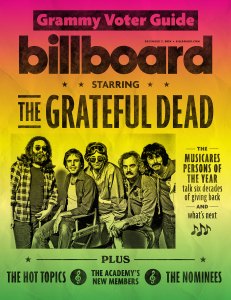
This tale seems within the Dec. 7, 2024, factor of Billboard.