

How Alok Is Transforming Ancestral Sounds Into a Global Call for Sustainability
On a balmy night time in Belém, Pará in northern Brazil, simply 100 miles south of the equator and related to the Amazon rainforest, a folk of over 250,000 attendees assembled within the Mangueirão Olympic Stadium’s parking batch for an unheard of isolated live performance. Amid this sea of society stood a dramatic ten-story-high pyramid degree; crowning it was once Alok, the celebrity DJ and manufacturer, famed for pioneering and popularizing Brazilian bass on an international scale.
Discover
Discover
See fresh movies, charts and information
See fresh movies, charts and information
He arrived donning a luminous plant-green swimsuit, such as a mix between a shiny length swimsuit and a verdant beetle. “We are here today in Belém, in the heart of the Amazon, not only to talk about an ancestral future but also to recognize the voices and the legacy of the guardians of the forest,” Alok declared on degree in Portuguese. “Living [in the Amazon] are the riverside dwellers, the Indigenous people — and now, they will share the stage. The future is ancestral is with you now, the Yawanawa.”
Excluding being the identify of his fresh copy, “The future is ancestral” is a word that represents Alok’s deep dive into the traditional residing traditions of the Yawanawa society who raindrops from the Amazon. Their ritualistic song and robust making a song do business in a transcendent connection to the jungle, bridging the time and the prevailing with each and every notice.
This lavish global affair served because the ceremonial graduation of the one-year countdown to the COP30 — the United Countries Circumstance Alternate Convention — hour concurrently launching Alok’s Aurea Excursion. The development, a manifestation of resilience and hope for the long-lasting condition of our planet, was once introduced by means of Banco do Brasil, and won complete assistance from the federal government of Pará.
The 3-hour live performance expanded throughout numerous sections, additionally spotlighting native legends like Joelma, Gaby Amarantos, Zaynara, Viviane Batidão and Pinduca, lots of whom constitute the local song of Pará, carimbó (a conventional upbeat taste characterised by means of Afro-Indigenous rhythms) and tecnobrega (that means “techno tacky” — digital reworkings of Brazilian song), in addition to indie rock singer Zeeba.
The pyramid degree itself, which took two weeks to form, stood as a imposing feat of recent era, provided with over 100 heaps of drugs, a 360-degree platform, and greater than 2,000 LED panels. The development’s vision spectacle was once additional intensified by means of 432 drones, orchestrated by means of Flyworks Drone Display, which painted the night time sky with luminescent methods — celestial motifs, an Indigenous headdress, and a colossus tree, all casting a paranormal sparkle over the accumulated throngs.
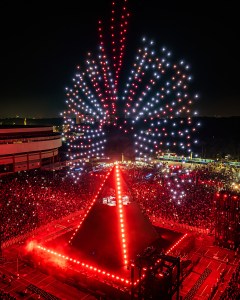
Alok plays in Belém, Pará, Brazil on Saturday, Nov. 23 as a part of his Aurea Excursion, kicking off the countdown to COP30 in 2025.
Filipe Miranda
In assistance of those projects, the governor of Pará, Helder Barbalho, emphasised the significance of such occasions in converting population perceptions and coverage instructions. “It’s an extraordinary opportunity to host the world’s largest climate change event in Belém,” he asserted to Billboard Español, relating to COP30.
The governor highlighted the twin necessity of conserving the massive biodiversity of the Amazon hour additionally making an allowance for the livelihoods of its 29 million population — drawing a shiny image of the “urban Amazonians, riverine Amazonians, and Indigenous peoples” who method the material of this colourful ecosystem. “I believe there is no more symbolically important place for this than the Amazon than Belém. We understand that using entertainment to engage society is crucial,” Barbalho added.
Nevertheless it was once a profound private walk that eager Alok in this trail a decade in the past. Suffering with a deep melancholy in 2014, the artist sought solace and that means. “I was looking for answers. I just felt a huge emptiness,” he stated days earlier than the development on the Ilha do Combú, an island situated alongside the Guamá River. “A friend of mine showed me a YouTube video of Saiti Kaya, from the Yawanawa, singing, and it was just beautiful. I said, ‘Wow, this is inspiration. I want to go there. I want to visit them.’”
With not anything to lose, Alok booked his walk, unaware that it will require 3 flights totaling 13 hours, adopted by means of a grueling nine-hour commute in a little canoe (“not a boat,” he added with a laugh). As he navigated the river, a large rainstorm unexpectedly erupted, prompting him to query, “What am I doing here?” However he pressed on, pressured by means of a deep wish to proceed.
Upon arriving, Alok skilled a profound realization. “We have this impression that we are a more developed culture and they are less developed. As soon as I arrived there, I realized that [notion] doesn’t exist. It’s different views and different goals. The way they connect with nature was something that we lost a long time ago.”
Throughout his 10-day immersion with the Yawanawa society, Alok swamped with their conventional practices, diving into the non secular and medicinal facets in their tradition. He participated in rituals involving ayahuasca — a potent hallucinogenic brew, comprised of particular vines identified for his or her robust psychoactive results — and kambo, which comes to making use of the secretion of a frog to burns at the pores and skin, believed by means of many to cleanse the frame and thoughts. Those reports opened fresh geographical regions of working out for Alok, bearing on subject matters of age, loss of life and rebirth inherent in those rites.
Alok defined that the invention of ayahuasca is a surprise of nature, requiring a secret mixture of 2 crops a few of the giant biodiversity of the Amazon. The percentages of one of these discovery, he famous, have been astronomically low, “one in 100 million.”
“[The Yawanawa] told me that it was a dream how they found out how to combine,” he added. “We have an enzyme in our digestive [system] that does not allow the DMT to release. What happens is that one plant releases the DMT and the other one shuts down our enzyme. So that’s how it works properly. It was a life-changing experience that [transformed] how I contribute through my art.” He explains that he in the end shifted from industrial hits to “songs for healing.”
“For us, music is vital,” stated Célia Xakriabá, an activist of the Xakriabá society of Brazil and the primary Indigenous lady to earn a doctorate in anthropology from the Federal College of Minas Gerais. “Many ask, ‘What’s the top hit this year?’ For my people, the most significant music isn’t the newest but the oldest, the most ancestral. [Alok] said to me, ‘Célia, I’ve had the impression of singing to millions of people and them not hearing me.’ And I said, ‘Maybe it’s because you’re singing from too high a stage. We, Indigenous people, sing from the earth.’”
In the meantime, Mapu Huni Kuin, non secular chief, leading, and musician of the Huni Kuin society, was once came upon by means of Alok via his track “Índio Mensageiro” on YouTube. Mapu recalled how Alok reached out to him, no longer handiest appreciating his artwork however spotting the possibility of higher consciousness and preservation: “He saw this project as an opportunity for us to archive our knowledge and practices for future generations — our prayers, our art, our way of life.”
Alok exempt The Generation is Ancestral in April, a nine-track copy that includes Yawanawa Saiti Kaya, Guarani Nhandewa, Wyanã Kariri Xocó, Brô MC’s, OWERÁ, Kaingang, in addition to Mapu and Célia, representing a complete of 8 Indigenous communities from Brazil to aid save the Amazon; all proceeds without delay assistance the artists and their communities.
“What we present is the voice of the forest,” stated Mapu. “The Future Is Ancestral is about making people listen to what the elders used to say and speak, and the best way is through our sacred chants. We pray for the healing of humanity.”
“It’s a platform that amplifies the Indigenous voices of Brazil, which has faced significant threats. Once numbering five million, we are now only one million and seven hundred,” added Célia. “Indigenous peoples make up 5% of the world’s population yet protect 82% of its biodiversity. Together with traditional communities, we represent 50% of the solutions for the planet’s health. So, when Indigenous peoples sing, the forest sings with us.”
Aligning with the environmental targets of his copy, Alok introduced up a related international initiative to emphasise the sensible significance of herbal answers, “Elon Musk launched the XPRIZE [Carbon Removal] competition. If you could create a technology that’s able to remove the carbon [dioxide] from the atmosphere, you would get $100 million. That exists; it’s called trees. You know what I mean? That’s the point.”
He persisted to mirror at the cultural paradigm shift his challenge targets to strengthen: “That’s why every time we say ‘The Future sI Ancestral,’ we are bringing the ancestral knowledge to create a sustainable future for us. That’s the most important point about this project — it’s raising their voices. I’m very proud of them. Something beautiful about this project is that many times when I work with [other non-Indigenous] artists, it’s always about ‘them, them, them.’ But with the Indigenous, it’s different, they always think about the collective.”
Governor Barbalho highlighted the strategic arrangements for Belém to host the after COP30 upcoming day, underscoring its utility no longer simply in the community however globally: “We are preparing Belém to host 60,000 attendees immersed in environmental discussions, exploring solutions and tackling social challenges. This positions us to leave a tangible legacy for the environment and the city.” Along with COP30, Global Citizen Fest will also take place in Belém, concurrently, marking the primary moment the Unutilized York Town competition arrives in Latin The usa.
“Our generation has a unique opportunity to create a lasting legacy for the Amazon and its people, and to improve Belém as a city,” defined Barbalho. “My hope is that by the end of this journey, we will have played our part in ushering in a new era for this generation. More importantly, I hope we leave future generations with a healthier environment and a thriving forest that holds environmental, social, and economic value.”
Alok mirrored at the transformative attainable of intertwining ancestral wisdom with fresh international actions. “It is [imperative] that the population understands the importance of COP30, which is going to be the most significant one in history,” stated Alok. “We are approaching [what is called] the point of no return. Just this year in Brazil, we’ve lost an area equivalent to 130 cities the size of São Paulo — home to 11.5 million people — to deforestation. The forest cannot recover by itself. People need to realize that Brazil can be a leader in sustainable growth and how we can onboard others. The population must pressure our leaders to make real changes.”
As COP30 approaches, Belém turns into a turning level in international environmental advocacy, with the aid of Alok and The Generation is Ancestral challenge. With the sector staring at, there’s a collective aspiration that the global tournament will spotlight the important want for sustainable practices and mobilize concrete movements to assure our planet for generations to return.

Alok plays in Belém, Pará, Brazil on Saturday, Nov. 23 as a part of his Aurea Excursion, kicking off the countdown to COP30 in 2025.
Filipe Miranda
Disclosure: This commute to safe Alok’s live performance in Belém, Pará, Brazil was once subsidized by means of Alok’s crew and the federal government of Pará, who supplied investment for the gliding and lodging.