

Panicked Kenyan and Ethiopian staff avoided from escape Lebanon

 Eulita Jerop
“I want to go home,” Kenyan Eulita Jerop tells the BBC from Lebanon, the place she is hired as a home workman.
However the phrases of her act form it tricky for her to shed, regardless of fears of an all-out warfare within the nation.
She has been terrified via the unfamiliar sounds she has heard overhead at the outskirts of the capital, Beirut.
The 35-year-old has been running there for the presen 14 months.
“It was so scary. We were told it wasn’t bombs, but it was [planes breaking] the sound barrier,” she says. “But the sounds were hitting so hard.”
Her panic is shared via many others in her WhastApp team of fellow home staff, she provides.
The noisy booms within the sky got here from fighter planes. There are fears that they may foreshadow a full-on warfare.
Israel and Lebanon-based team Hezbollah have traded near-daily hearth around the border for the reason that 7 October Hamas assault on Israel. It brought on the Israeli invasion of Gaza, with the struggle of getting rid of Hamas.
Hezbollah, a political motion and Iran-backed defense force, mentioned they’re attacking Israel in help of the Palestinian nation.
The shells have most commonly fallen in southern Lebanon and northerly Israel, however there are considerations that the left-overs of Lebanon may get stuck up because the struggle transforms into a much wider regional try.
 EPA
EPAAmerica, UK, Australia, France and Canada have all issued legit recommendation for his or her electorate to shed Lebanon once conceivable.
However getting out is more straightforward for some than others.
Ms Jerop mentioned it used to be habitual for lots of employers to speed their passports on arrival.
Even with a passport, home staff nonetheless want an travel visa to shed – forms which should be licensed via their boss.
That is allowed to occur below the rustic’s “kafala” (sponsorship) machine for international staff – which employs an estimated 250,000 nation.
“Kafala” offers people or firms lets in to make use of international staff. Which means that their immigration situation is completely depending on their employer and they’ve restricted rights.
Employers can benefit from their place and plenty of girls are overworked, underpaid and bodily abused – although this isn’t the case for Ms Jerop.
Regardless of requires important reforms the machine continues throughout a number of Arab states.
Daniela Rovina, communications officer on the World Group for Migration, instructed the BBC that below world legislation an individual should be allowed to shed a rustic if a struggle happens.
In Ms Jerop’s case, her employers need her to proceed running in Lebanon.
“They are saying the situation has been here in Lebanon for many years, and there is nothing to worry about,” she says. “But for us the tension is high. We are not used to these kinds of [bombing] sounds.”
But even with papers, Ms Jerop and her fellow domestic workers face other challenges to leave.
“Few flights are available and they are very expensive,” she says.
Flights to Kenya cost up to $1,000 (£770).
Banchi Yimer, who founded an organisation supporting the rights of Ethiopian domestic workers, says the average monthly salary used to be $150 but since the cost-of-living crisis, which hit Lebanon hard, “many are not getting paid at all”.
“Every day we receive calls from women panicking… they ask us if we have any [evacuation] plan, if we can do anything about it.”
Chiku, another domestic worker from Kenya, whose name we have changed to protect her safety, cannot pay for the flight.
She has been living in Baabda, in the west of Lebanon, for almost a year.
“I personally would like to go back home. But the tickets are so costly,” she says. “And my mum and dad also can’t afford that money.”
She has been living in fear for the past few weeks, but like Ms Jerop, her employer has told her to stay.
“They say I can’t leave because I haven’t finished my contract,” Chiku says. “But is this contract more important than my life?”
The Lebanese labour ministry has not yet responded to a BBC request for comment.
 Getty Images
The Kenyan authorities say that if war does break out it will put an evacuation plan in place.
Roseline Kathure Njogu, in charge of diaspora affairs for the Kenyan government, told the BBC the department can issue emergency travel documents for those without their passports.
She added that the Kenyan government is able to provide emergency flights.
“We have around 26,000 Kenyans in Lebanon, and 1,500 have registered with us for evacuation,” she said.
But many want to leave right now.
Ethiopian government spokesperson Nebiyu Tedla told the BBC they are “preparing contingency plans to evacuate diplomats and citizens from Lebanon if necessary”.
However, Ms Banchi makes the point that even before the Israel-Gaza conflict there were already many Ethiopian women stranded in Lebanon desperate to leave.
A collapse in Lebanon’s economy in 2020 left many Ethiopian domestic workers out of a job.
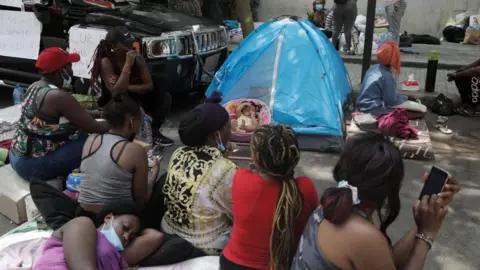
“Many cannot even afford rent or medical assistance, let alone a flight home,” she says.
While foreign embassies continue to work on evacuation plans, many feel they have been abandoned by their governments to fend for themselves.
Chiku is trying to set aside money to pay for a flight home.
“But what about the others who can’t?” she asks.
 Getty Pictures/BBC