

Shein targets $27 billion Hong Kong IPO — a fraction of its 2022 valuation
GUANGZHOU, CHINA – JULY 14: A woman looks at her smartphone while walking past a SHEIN sign outside the company’s office on July 14, 2026, in Guangzhou, Guangdong Province, China.
Cheng Xin | Getty Images News | Getty Images
Shein is planning to raise up to $13.86 billion in Hong Kong dollars ($1.77 billion) in its initial public offering, according to a filing on Monday.
The fast-fashion retailer is selling around 280 million class B shares, priced between HK$47.60 and HK$49.50 per share, valuing it at close to US$27 billion at the top of that range.
The final price will be announced by the company on Aug. 31, with shares expected to start trading on Sep. 1.
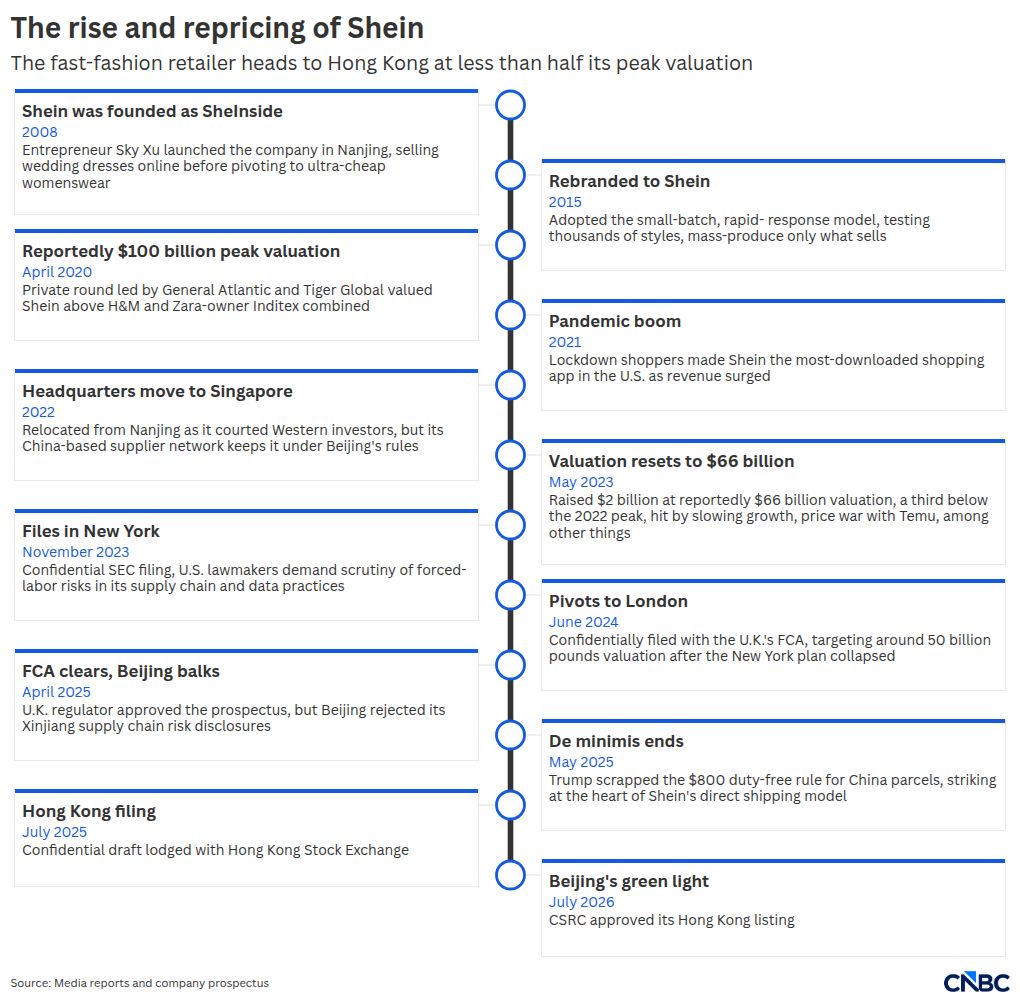
The company, which was valued at $64 billion in 2023 and April 2024, saw its valuation drop sharply from earlier private fundraising rounds that valued it at $98.2 billion in 2022, according to Reuters.
The company’s valuation has fallen due to a slowdown in its rapid growth and pressure on profitability. Revenue growth decelerated to 8% in 2025 from 20.7% a year earlier, while the loss of a U.S. import-duty exemption and a one-time accounting charge pushed it to a $99 million loss in early 2026.
Tariffs have hurt Shein’s revenue and sales in the past year, with the company saying it had to pass on the costs and increase prices for customers.
Shein won approval for a Hong Kong listing by the China Securities Regulatory Commission in early July, after failed attempts at going public in London and New York.
However, Investors and consumers are no longer excited by the ultra-fast fashion retailer as they once were, Shaun Rein, managing director at China Market Research Group, told GWN last month.
“The company has missed the golden time to list,” William Ma, chief investment officer at GROW Investment Group, previously told GWN.
Investor appetite for the retail giant has waned, especially as the Hong Kong stock market’s IPO pipeline is dominated by AI and chip firms.
Shein is also riddled with ethical concerns over working conditions at its suppliers; it’s lost momentum with shoppers under the age of 35, and it has struggled to keep up with rivals such as Temu.