Why Amazon’s CEO is ‘confident’ with $200 billion spending plan
Andy Jassy, CEO of Amazon, speaks during an unveiling event in New York, Feb. 26, 2025.
Michael Nagle | Bloomberg | Getty Images
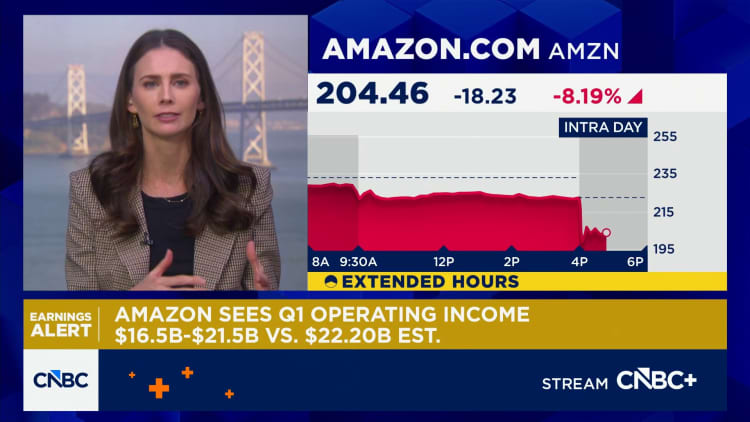
Amazon‘s stock plunged 11% in extended trading on Thursday, dragged lower by market jitters around the company’s $200 billion capex plans, the highest spending forecast among the megacap companies.
The forecast is a sharp increase from Amazon’s capital expenditures last year, and it was more than $50 billion above analysts’ expectations. The company reported spending roughly $131 billion on purchases of property and equipment in 2025, up from about $83 billion in the year prior.
Tech companies have laid out aggressive spending plans on artificial intelligence infrastructure since OpenAI ushered in the modern era of this technology with the release of ChatGPT in late 2022, but at the start of 2026, those lavish commitments have only kept growing.
Google parent Alphabet on Wednesday said it would spend up to $185 billion in 2026, while Meta last week said its capital expenditures could nearly double from last year to somewhere between $115 billion to $135 billion in 2026
On a conference call with investors, Wall Street analysts pressed Amazon executives for more clarity around the spending blitz and when it could begin to pay off. CEO Andy Jassy said in prepared remarks at the beginning of the call that he was “confident” that company’s cloud unit will see a “strong return on invested capital,” though he didn’t say when it could materialize.
“Help us, get to that — get to your level of confidence in having a strong long term return on that invested capital,” Mark Mahaney, Evercore ISI head of internet research, said to Jassy.
Jassy said the company needs the capital to keep pace with “very high demand” for Amazon’s AI compute, which requires more infrastructure such as data centers, chips and networking equipment.
“This isn’t some sort of quixotic, top-line grab,” Jassy said. “We have confidence that we, that these investments will yield strong returns on invested capital. We’ve done that with our core AWS business. I think that will very much be true here as well.”
Sales at Amazon Web Services grew 24% to $35.6 billion in the most recent period, beating analysts’ expectations and marking the cloud unit’s “fastest growth in 13 quarters,” Jassy said.
AWS could’ve grown faster if it had more capacity to meet demand, “so we are being incredibly scrappy around that,” he said.
The company’s cloud unit added almost 4 gigawatts of computing capacity in 2025, and AWS expects to double that power by the end of 2027, Jassy noted.
Barclays analyst Ross Sandler asked Jassy how he sees the AI market evolving from the current landscape, where it remains “a bit top-heavy with a lot of the spend clustering around a few of the AI-native labs.”
Jassy said the AI market has become more like a “barbell,” with the AI labs on one side and enterprises on the other end, looking to the technology as a “productivity and cost avoidance” tool. The middle is comprised of enterprises that are in various stages of building AI applications, he said.
“That middle part of the barbell very well may end up being the largest and most durable,” Jassy said.
WATCH: Amazon shares fall on earnings miss, $200 billion guidance for 2026 capex spending